L33T KV
A KV store that beats Redis 6.0. Ranked 1/40 grad students in a KV store competition.
root@l33t:~$ ./bench --servers 3 --ops 300000

throughput   36,234 ops/sec
avg latency  0.080 ms
redis 6.0    35,670 ops/sec
rank         1/40 grad students

root@l33t:~$ _
Four iterations and the true bottleneck discovery.
The setup
A 19-byte binary instead of human-readable text.
A key-value store is a brutally simple thing. Two verbs: SET and GET. The interface is so small that almost all of the cost lives in the wire and the network.
Most KV stores reach for Redis's RESP, a human-readable text protocol that costs seventeen to twenty-three bytes of framing per op. L33T spends three. One byte for the opcode, two bytes for a big-endian length, then the payload. The receiver is a machine. Humans don't need to read it.
Try it. The panel beside this text, or below it on a phone, runs your command through the same WASM-compiled parser the server uses. Click Run and watch it break the bytes apart.
Python asyncio
The reference baseline. Whatever you do next, you compare against this.
Vanilla asyncio, dict-backed store, one server per port behind a client-side modulo shard. Three shards, three benchmark threads, one hundred thousand ops each. Sync per op, no pipelining. The numbers come back honest.
Result: 0 ops/sec.
Everything that follows is an argument about where the missing throughput went.
uvloop + tightened Python
Swap the event loop. Cache the struct. Local-bind the hot-path globals.
uvloop swaps asyncio's event loop for one built on libuv. The wire format stays the same and the loop just dispatches faster. After that comes a round of tightening: cache the struct.Struct so it is parsed once, use readexactly instead of a hand-rolled read loop, and local-bind the hot-path globals so the bytecode emits LOAD_FAST instead of LOAD_GLOBAL.
Result: 0 ops/sec. A 2.3x lift without leaving Python.
Most of the gain was the loop. Some of it was the bytecode. None of it was rethinking the design.
C epoll
Hand-written hashtable. Edge-triggered epoll, drain to EAGAIN. No allocator surprises.
The server is about four hundred lines of C. The hash table uses with open addressing and linear probing, with tombstones to mark deleted slots. Each connection has its own read and write buffers. The epoll loop runs in edge-triggered mode and drains every socket until the kernel returns EAGAIN. The listening socket has TCP_NODELAY set so the kernel does not hold packets waiting for more payload.
Result: 0 ops/sec.
From here on, tightening server code does almost nothing. The bottleneck has moved off-chip. Drag the RTT slider in the panel. It starts at the lab's eighty microseconds and the throughput number is computed from real CPU cost measured in a WASM build of the same hashtable, plus whatever RTT you dial in. Watch what dominates as you change just the network.
io_uring
The fancy thing that gave nothing.
Same hashtable, same protocol. Replace epoll with io_uring. Try SQPOLL. Try larger ring sizes. The number does not move.
Why: the workload is synchronous per op, in-flight depth is around three, there is no batching to amortize. io_uring's whole pitch is amortizing syscall cost across many in-flight ops. We don't have many in-flight ops.
Knowing when not to use the fancy thing is the lesson. The bottleneck moved off-chip two ceilings ago. The CPU has nothing left to give.
The comparison: Redis 6.0
Same lab, same wire, same workload shape. Different protocol, different server.
Three Redis instances run on the same host with persistence turned off. The benchmark uses the native redis-benchmark client so Python overhead is removed from both sides of the comparison. Value sizes range from 8 B to 1 KB.
L33T KV wins at every size in the sweep. At 8 B the lead is 1.6 percent. At 1 KB it shrinks to 0.7 percent. Run-to-run variance is on the order of half a percent, so the smaller leads are effectively ties.
Per-node on loopback, Redis is roughly twice as fast as L33T KV. That gap is what fifteen years of allocator and string work buys. On the LAN, the network absorbs it.
Ranked 1/40 grad students.
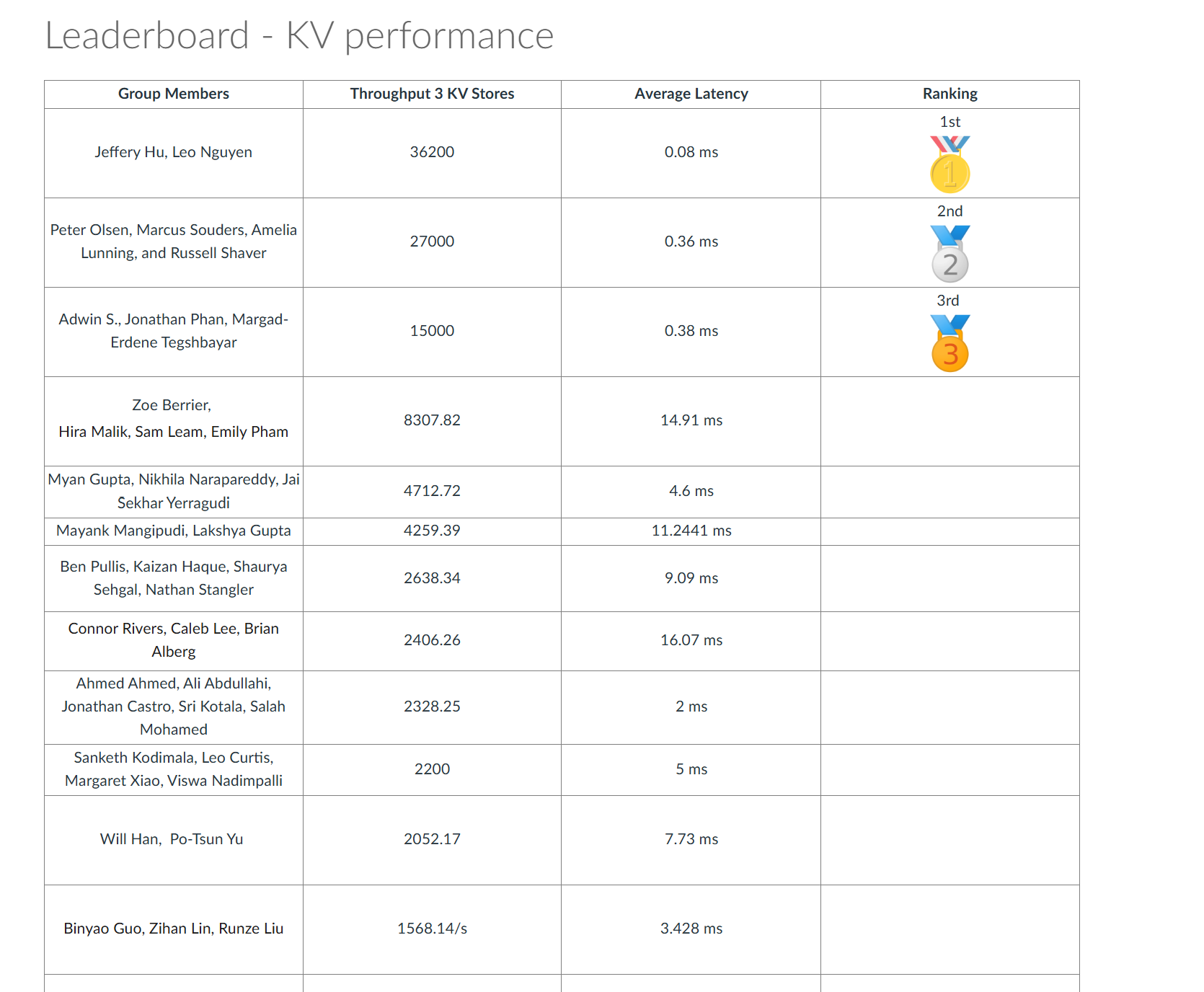
The store was the final project in a graduate Cloud Computing class, run as a KV store design competition. Forty grad students in twelve teams, one benchmark on the same lab. L33T KV finished first at 36,200 ops per second: thirty-four percent ahead of second place, and roughly four times the median team.
Second place ran at 27,000. Third at 15,000. Below that the field drops into the low thousands, mostly stores that never got the network out of the way.
root@l33t:~$ cat leaderboard.txt

rank         1/40 grad students
throughput   36,200 ops/sec
avg latency  0.08 ms
lead on 2nd  +34%
We beat Redis... But at what cost?
36,234 ops/sec to Redis 6.0's 35,670. A 1.6 percent edge that vanishes the moment you ask L33T KV to do anything Redis was actually built to do. Here is what got cut to claim those numbers.
What you give up to get the speed.
What this taught me.
L33T KV.
A KV store that beats Redis 6.0 by sacrificing everything Redis spent fifteen years building.